By Cornelius George · · 15 min read
Bet on Humans
Superintelligence was never something we build and then meet. It is something we become. What I found in a benchmark, then in my own head, then in the company.
In January I was rocking my daughter to sleep with a YouTube video playing on the other side of the room. The sound was off and the captions were on, because she was finally going down and I wasn't about to risk it. The video was about MIT's work on long context.
If you don't live in this world, long context is the unglamorous name for the thing standing between a chatbot and something that can actually carry your work. A model that can't hold enough of your situation in view has to be re-taught who you are every morning. Every serious lab is chasing this. It is, in a real sense, the whole game.
So there I was, one arm asleep under a baby, reading captions about the hardest open problem in artificial intelligence, and thinking: I don't think that's quite it.
I ended up in a back and forth with the MIT team about it. Not long after, I built my own general purpose agent and named it Neo. That became , which is now a product anybody can go use.
But the part I want to write about isn't the product. It's what I found underneath it, which turned out to be the same thing in four different places, and which changed what I think superintelligence actually is.
We have been asking the wrong question
The story we tell about superintelligence is a story about separation. Humanity builds an intelligence. The intelligence improves. Eventually it passes us. Then we are standing in front of something alien and vastly more capable, hoping we were careful.
Every version of that story puts the intelligence inside the machine and puts us outside it, watching.
Here is the question I ended up with instead: what happens when the thing that becomes superintelligent is the human?
Not through biology. Nobody is putting a chip in your head. And not because a model somehow pours an IQ score into you.
But because intelligence was never only about how much a system can hold. It is also about how efficiently a system uses what it already knows, where it keeps what it has learned, which constraints it can shed, and how fast it can push its own frontier outward.
Once I started looking at intelligence that way, I started seeing the same pattern everywhere I looked. In models. In agents. In my own head. In companies. Eventually in economics itself.
The pattern is almost embarrassingly simple. Use intelligence where intelligence is actually required. Keep what you have already learned in the cheapest layer that can hold it. Then point the freed-up intelligence at the next unsolved thing.
Do that on a loop and the frontier moves. Again. And again.
First I found it in a benchmark
We ran a replication of Recursive Language Models on the OOLONG long-context benchmark. The idea behind recursive approaches is roughly: when the problem is too big, call the model on pieces of it, then call the model again to put the pieces together.
We tried something different. We let GPT-5 do the part that genuinely required understanding, which was the semantic classification, and then moved the resulting structured information into plain deterministic computation.
On the 131K-token trec_coarse setting, that classify-and-count approach scored 63.38%, against the paper's reported 56.5% for GPT-5 RLM at depth 2 and 58% at depth 3. It needed roughly 320 model calls in the benchmark setting rather than the tens to thousands of recursive calls per query the recursive approach reports.
I should tell you that our first version of this had a methodology error. The RLM authors pointed it out, we published the correction, fixed the labels and the scoring and the benchmark setting, and ran it again. The narrower finding survived the correction.
The lesson was not that models are unnecessary. It was closer to the opposite: don't waste the model. Classification needs semantic intelligence. Counting does not. So let the model understand, let structure retain, let cheap computation reuse, and send the model back out to the next edge.
That is a technical result about a benchmark. I would have left it there if I hadn't started noticing the same shape one level up.
Then I found it in my own head
Think about what it would cost to make an agent reconstruct your entire life on every single interaction. Who you are, what happened yesterday, who your spouse is, what you decided last week and why. Absurd. So you keep the durable things cheaply, in memory and relationships and stored decisions, and you leave the enormous general knowledge in the model, and the agent moves between them.
Same pattern. Keep the stable stuff cheap. Spend real intelligence at the edge.
Now go up one more level, and this is the one that got me.
I ask my agent to help me with something I could not do yesterday. It doesn't just hand me an answer. I'm in it. I see a relationship I hadn't seen. I learn a word I didn't have. I understand why the first approach failed. We solve the thing.
And then here is what actually matters: I do not go back to who I was before.
My brain changed. I know something now. I can recognize a shape I couldn't recognize last week. The next time something in that neighborhood comes up, a piece of what used to require outside intelligence is now sitting inside me.
Meanwhile the agent remembers what we learned together. So neither of us starts over. The next problem begins from a higher floor. We attack that edge. I learn again. It persists again. The floor rises again.
That is the recursion, and it is why I think saying the intelligence lives "in the coupling" is not quite right either. The coupling is the mechanism. The human is what gets more capable.
This is also why the current gap bothers me so much. Pew found in June that about 24% of American adults use AI chatbots daily. That sounds like everyone. But using a chatbot is not the same as owning an agent, and our own working estimate is that maybe 2% of people have real agentic capability. That number is ours, not Pew's, and I want to be clear about which is which.
Look at who is inside that 2% and you'll notice they are not smarter than everyone else. They are people who were willing to grind through models and context and prompting and tools and memory and integrations and sometimes code, and to keep going long enough to assemble it into something that works. I know, because I was one of them and it cost me my nights.
Nobody should have to do what we did.
So Sontara was built so that an ordinary person never has to understand any of it. No model choice. No memory architecture. No workflow builder. You don't even need to know what "agentic" means. Two minutes and you have an agent, organized around the most obviously persistent thing in the entire system, which is not the model and not the tools.
It's you.
Around the fourth real message, something shifts. The question stops being what can AI do and becomes what can I do now. We call it the Sontara Moment, and it is not the machine getting better. It's a person's sense of their own possibility changing. By around the seventh message, the goal isn't that they have a plan. It's that they've already done real work against something actually in their life.
Two minutes to access. Four messages to realization. Seven to action. That is the 98 percent to 2 percent trip, compressed from years of obsession down into a conversation.
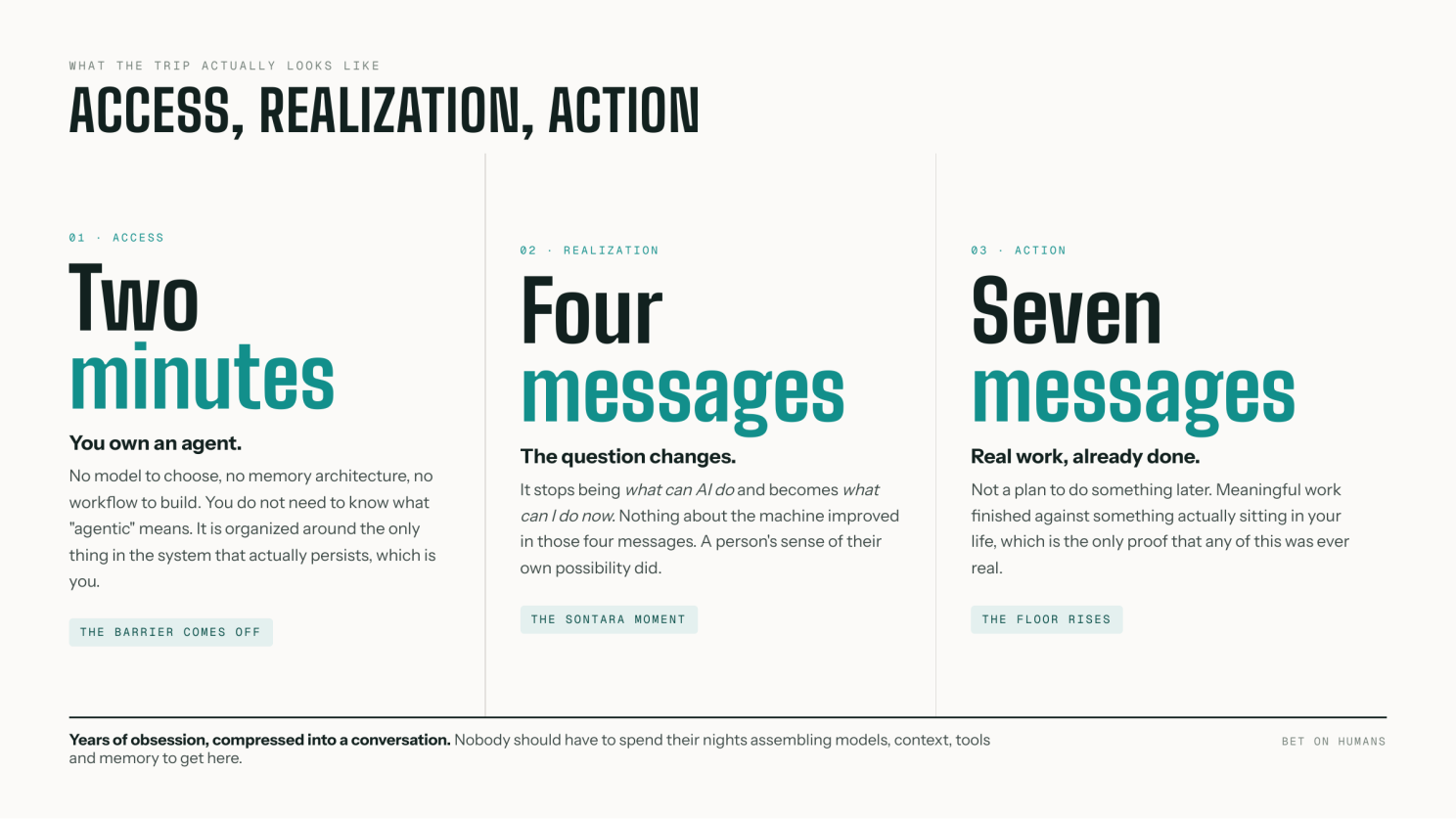
Years of obsession, compressed into a conversation.
Then I looked at my own company and found it again
Once you start seeing intelligence as constraint removal, you notice that most of what holds people back has nothing to do with thinking. It's access. Capital. Credentials. Distribution. Somebody's permission.
So we turned the same question on ourselves.
A normal company spends enormous money predicting who will produce a result. Hire him, he worked at the right place. Fund her, she went to the right school. Pay the ad platform, the algorithm thinks these people might buy. Build a sales team. Buy leads. Optimize acquisition cost against lifetime value, and when the ratio looks good, spend more.
None of that is stupid. It exists because for most of history, predicting capability was cheaper than giving everyone a chance to demonstrate it.
That is exactly the equation that just changed.
So: why predict who can create the result, when we can open the door and pay whoever actually creates it?
Anyone can . No résumé, no interview, no follower count, no sales history, no relationship with us, no requirement to even buy the product. Claim a code, create adoption, get paid. Partners move through 20, 25, 30 and 35 percent, and keep a 5 percent residual after the first year, which means the work doesn't evaporate at the transaction. It becomes a book. An asset. A small economic engine somebody built without incorporating anything, raising anything, or inventing a product.
This is equal access, and I want to be careful, because it is not equal outcomes. Someone with twenty million followers and someone with twenty are not secretly the same. A Fortune 500 and an unemployed parent are not holding the same hand. We are not pretending. What we can remove is the artificial gate between the person and the opportunity. Everybody gets the door. What happens after they walk through it is theirs.
Then we found another inefficiency. If somebody finds Sontara with no partner code attached, conventional economics says we simply keep the difference. But if that 20 percent exists because distribution creates value, why should we pocket a windfall just because nobody happened to get credit?
So we're creating an economic partner where none existed. Unattributed revenue routes its base partner economics, residual included, into a Partner Investment Fund, and that money exists to invest in partners.
Look at what each layer is attacking. Sontara goes after scarcity of capability. The partner program goes after scarcity of opportunity. The fund goes after scarcity of capital.
And then the last one, which is the piece I care most about. Companies find advisors by hunting for proxies: twenty years in the industry, a famous former employer, the right university, a VC introduction. All of those are attempts to answer one honest question, which is who is extraordinary?
We can just ask it directly. Don't ask whether someone understands distribution. Let them distribute. Don't ask if they can make people understand Sontara. Watch whether they do.
If the ecosystem reaches 35,000 customers by December 31, we'll identify the Sontara 7: three leaders by revenue, three by accounts, one exceptional combined. Seven seats, and 7 percent ownership of Human Frontier Labs set aside for that first group. Full terms go out in writing before the first seat is filled.
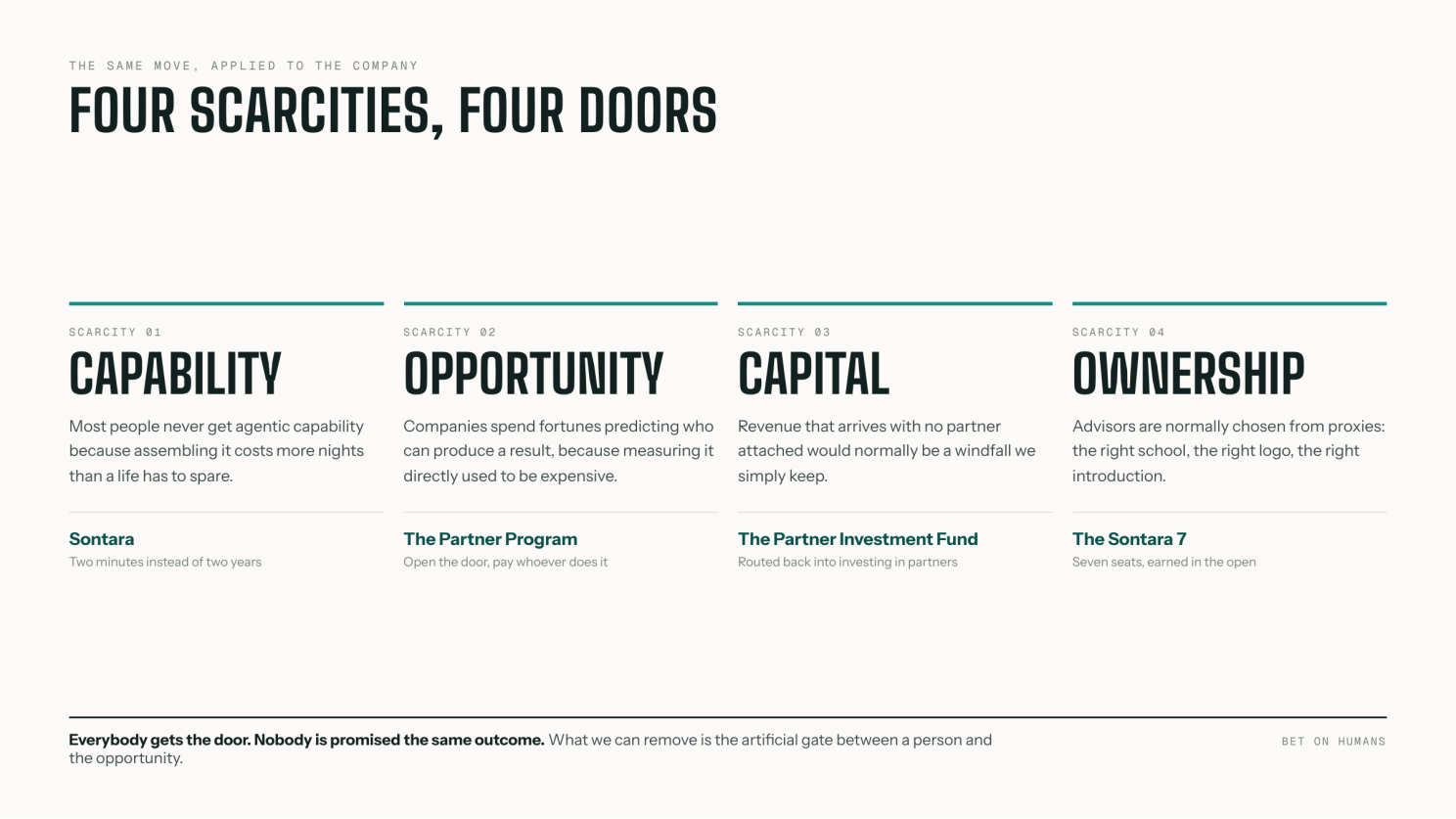
Four scarcities, four doors. Everybody gets the door; nobody is promised the same outcome.
The economics should not work
Add it up: we discount customers, pay large commissions, pay residuals forever, route unattributed economics away from ourselves, and dilute the founders by 7 percent to bring in people we haven't met yet.
Intuition says that's lovely and it costs margin.
Our model says otherwise. At a modeled 35,000-customer base, year one projects roughly $38.7 million in revenue and $16.3 million in profit, a 42 percent margin. Year two, about $46.9 million and $26.4 million, 56 percent. Year three, about $51.6 million and $29.2 million, 57 percent. Three-year cumulative profit around $71.9 million, with about $16.4 million paid out to partners.
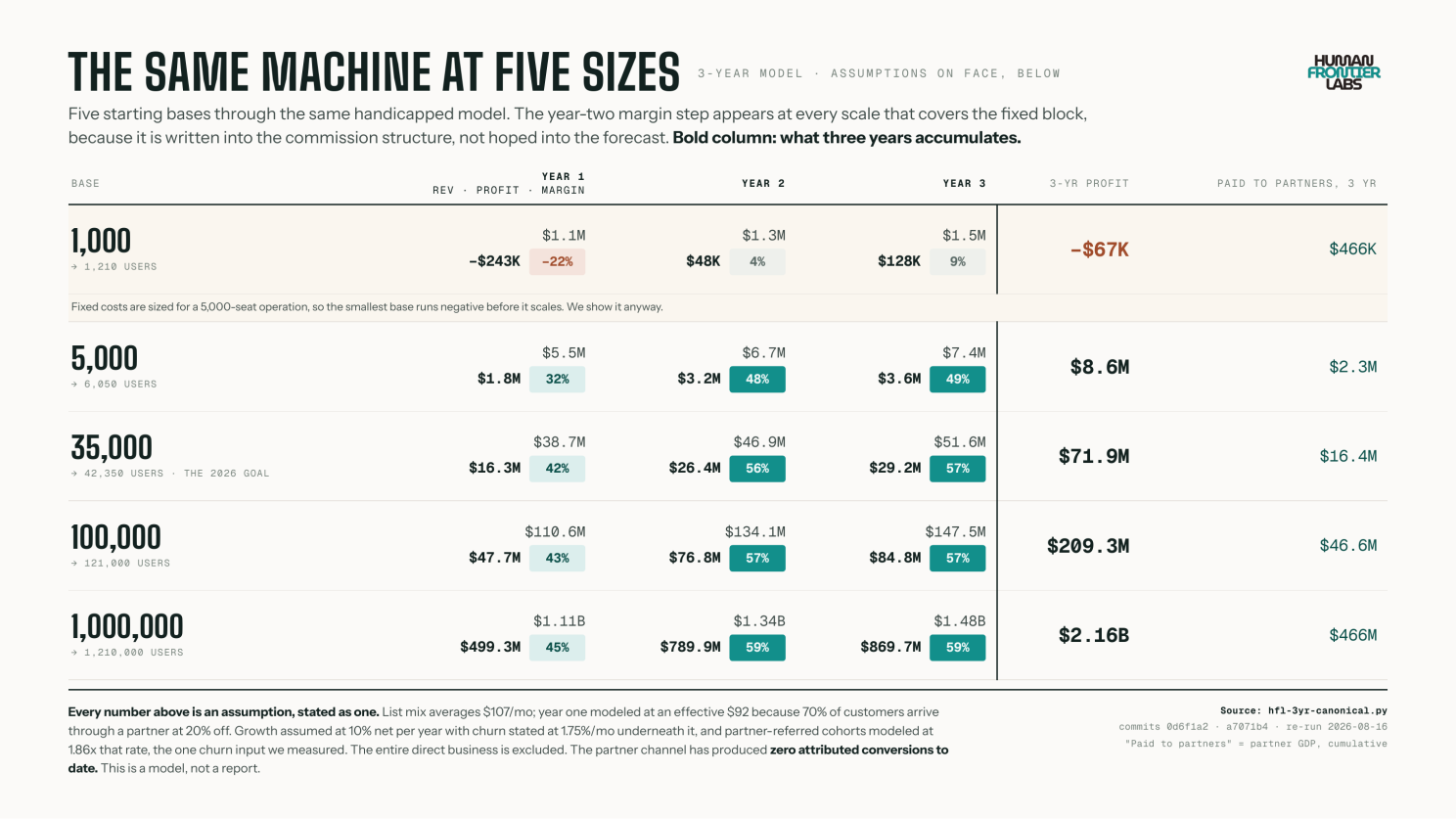
Modeled, not measured. The assumptions sit on the same page as the numbers.
Those are projections, not results, and they ride on stated assumptions: $92 per user per month, 10 percent annual growth, churn stated rather than benchmarked. And the honest part, which I would rather say myself than have somebody discover: the partner channel has not produced a single attributed conversion yet. Not one. It is built and published and wired, and the scoreboard reads zero.
If transparency only shows up once the numbers are good, it was never transparency. It was a press release with better timing.
I'll tell you where the money came from too, because it's the best evidence I have for any of this. Before there was a company, we made a few thousand dollars and used it to start one. We generated about $55,000 after that. We found a Google Cloud credit program open to Techstars alumni, applied, and got $350,000 in credits. Across all of it, roughly $26,000 of cloud compute, about $3,500 of Anthropic credits and around $5,000 of subscriptions produced the work I'm describing. Sontara went from nothing to a live product in about four months.
Human Frontier Labs has been profitable from the first dollar, because it was built out of revenue instead of capital.
And two weeks ago we closed the door on outside capital permanently. The investors who rolled forward hold the last outside position this company will ever take. From here we fund ourselves out of what we earn. If you are going to argue in public that the economics of a company can be redesigned, you should probably be willing to run the experiment on your own balance sheet.
Most of what we call merit is inefficiency wearing a suit
I don't think companies are bad, or that capitalism is the villain. My criticism is quieter than that.
Our economy is full of inefficiency that we have trained ourselves to read as evidence of value.
Ten thousand employees is impressive, unless five hundred could have done it. A $500 million raise is impressive, unless a different architecture solved it for five. A hundred million dollars of customer acquisition is impressive growth, unless customers would have brought each other if you'd shared enough of the upside with them. An elite university may reflect genuine ability, but admission was downstream of a thousand unequal circumstances before the person ever sat an exam.
None of that means the person isn't extraordinary. It means the proxy is not the result.
We needed proxies because measuring capability directly used to be expensive. That cost just collapsed. Which means a whole category of things we filed under "unavoidable" quietly moved into the column marked "removable."
The other path
So here is the other path, and it isn't separation.
We couple the intelligence to the human. We make it persist around a life. The human learns from it, it learns around them, and what was expensive cognition becomes cheap structure. The freed cognition goes after something harder. The human absorbs the result and does not go back. More capable humans work with other more capable humans. Organizations do things that used to need organizations ten times their size. The surplus funds harder problems, and the solutions become the floor for the next layer.
Then superintelligence is not something humanity builds and then meets.
It is something humanity becomes.
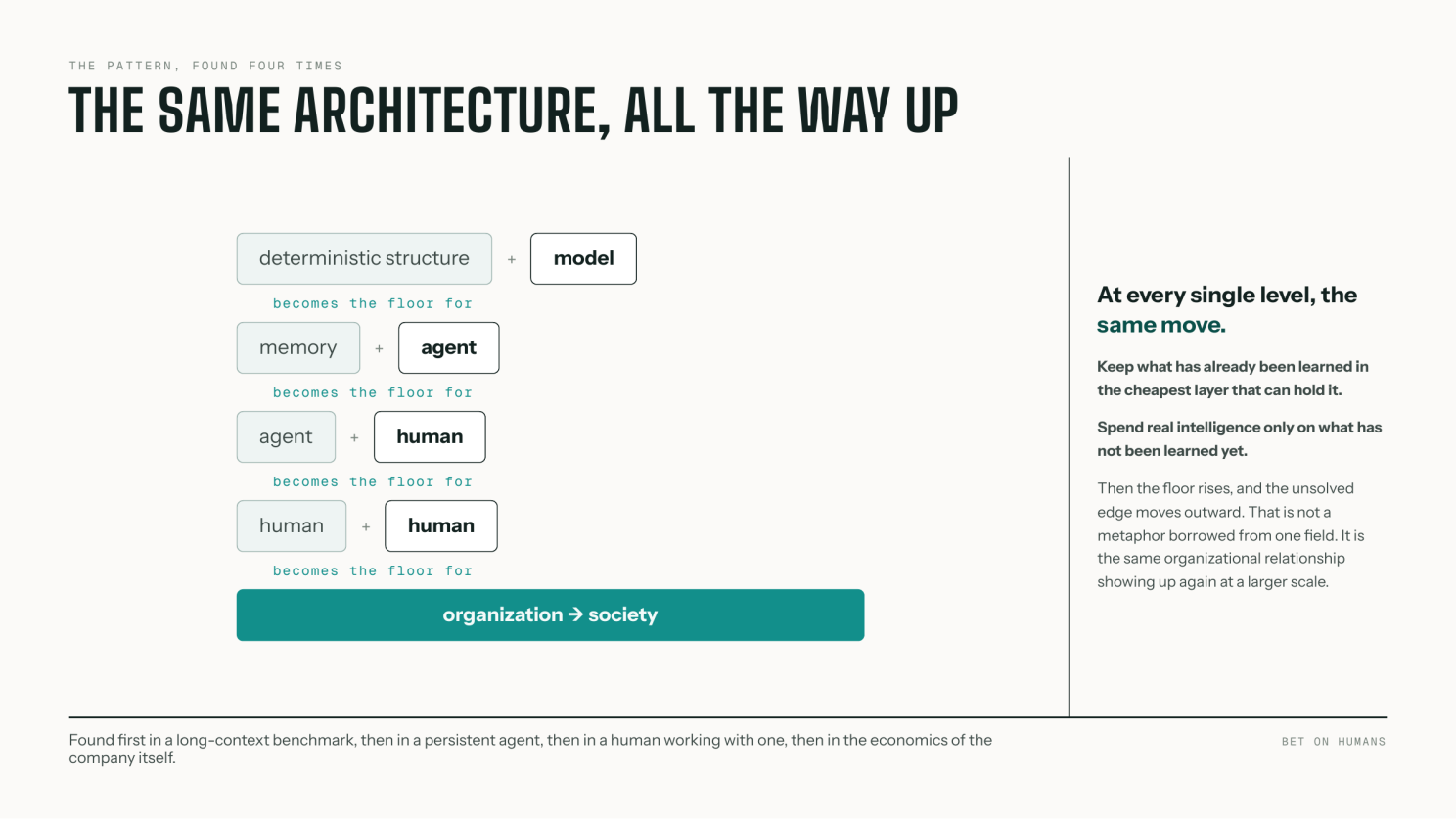
The same move at every level: keep what has been learned in the cheapest layer, spend intelligence on what has not.
Underneath most of our institutions is a buried assumption that humans are the constraint. That people need managing, opportunity needs gating, expertise needs credentialing, capital decides who is allowed to try, and if technology makes people unnecessary we'll have to pay them just to exist.
We're making a different bet.
Give people capability and see what they do. Give them a door without promising them the same outcome. Pay them when they create value. Let their work compound into something they own. When capital is the constraint, build a way for capital to follow demonstrated ability instead of demonstrated pedigree. When somebody extraordinary shows up, bring them inside and give them a real piece of it.
And when the thing throws off profit, don't only ask how much can be extracted. Ask what constraint we can take off a human being next.
None of these mechanisms is exotic. That matters to me. I don't think a better economy requires inventing a theory nobody can follow and then convincing eight billion people to adopt it. Make capability abundant. Make opportunity reachable. Make performance visible. Pay for contribution. Let work compound. Widen access to capital. Share ownership. Operate in the open. Then put the surplus back into what humans can do next.
Twenty years from now, if this works, the valuation will be the least interesting thing about it. The interesting question will be whether extraordinary profit, real technological progress, open access, shared ownership and human flourishing were ever actually in conflict, or whether that was just an artifact of constraints we hadn't learned to remove yet.
The greatest mistake we made imagining superintelligence may have been assuming we were building something to replace us. I think we were building the thing that lets us become more ourselves than we have ever been able to be.
Which brings me to the only promise in this entire piece that costs me anything.
We're building in the open, permanently. Any human on earth can ask to see our financials, what deals we're in, what the partner channel has actually produced, all of it, as long as it doesn't compromise a customer's privacy or the security of the system. Those two lines don't move. Everything on our side of them is yours to look at. Not a curated investor deck. The numbers.
I've just spent several thousand words telling you the machine works and the economics work and the humans are the point.
Go ahead and check.